Emergency Debris Management in the Gaza Strip
Emergency Debris Management in the Gaza Strip
An engineering-led early-recovery operation that reopens roads, secures neighbourhoods, and turns rubble into a resource for reconstruction
When the war stops, its dangers do not. Across Gaza City and the north of the Strip, mountains of rubble stand where homes, streets, schools and public facilities once stood. They block ambulances and relief trucks, cut neighbourhoods off from water and power networks, and keep families from returning to their land. Beneath the rubble lies something worse: explosive remnants of war, walls on the verge of collapse, and hazardous materials spreading with the dust.
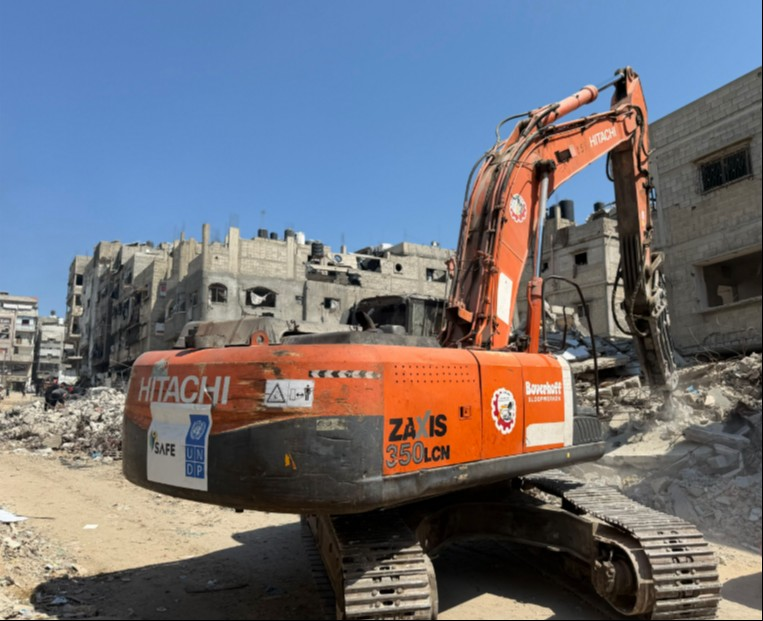
In response, the Gaza Society for Sustainable Agriculture and Friendly Environment (SAFE) is implementing the Emergency Debris Management project in the Gaza Strip, in partnership with the United Nations Development Programme / Programme of Assistance to the Palestinian People (UNDP/PAPP), funded by the Government of Norway through the Norwegian Ministry of Foreign Affairs, and in coordination with the municipalities and competent authorities in the target areas. The project does not stop at lifting rubble: it processes and reuses it in road rehabilitation, shoreline protection and the preparation of temporary shelter sites, alongside a community awareness programme that protects residents from the dangers of debris and war remnants.
Project Objectives
The project focuses on clearing debris from the most heavily damaged areas in a safe, risk-managed way, and on converting it from a humanitarian and environmental burden into a resource for reconstruction. It aims to:
• Demolish unsafe damaged structures, and sort and transport debris from critical infrastructure, roads, residential areas and public buildings
• Reopen roads and access to neighbourhoods, enabling families to return and services and assistance to reach them
• Crush, process and reuse concrete in road rehabilitation, shoreline protection and the preparation of temporary shelter sites
• Assess damaged buildings structurally and plan their safe demolition
• Raise residents' awareness of explosive remnants of war, protection from sexual exploitation and abuse, and protection and gender issues
• Support early recovery and prepare the ground for reconstruction
The Project in Numbers
• 167,000 tons of debris demolished, sorted and transported from critical infrastructure, roads, residential areas and public buildings to the nearest crushing site
• 105,000 m² prepared with recycled crushed concrete for road rehabilitation, shoreline protection and temporary shelter sites, after crushing, spreading, compaction and laboratory testing
• 10,000 households in Gaza City and North Gaza reached with safety messages through group awareness sessions and door-to-door visits
• Every truckload weighed and documented on a weighbridge card, then entered into a daily digital system that tracks tonnage, trips and equipment hours against the plan
• Works and engineering consultancy contracts awarded through publicly advertised competitive tenders, under the procurement procedures of SAFE and UNDP
From Rubble to Resource: How the Project Works
The journey begins with the risk-managed demolition of unsafe damaged structures, following a structural assessment that sets the method and sequence of demolition. Debris is then sorted on site: raw concrete, fine concrete, and non-concrete materials that are separated and taken to approved disposal sites. The concrete travels in documented truckloads to the nearest crushing site, where it becomes graded aggregate and undergoes the required tests before returning to the field as road layers, shoreline protection and levelled ground for temporary shelter sites.
Rubble thus turns from a burden to be buried into a local building material, at a time when construction materials are scarce and hard to bring in. Every ton recycled saves an imported material, shrinks the dumps, and reduces the environmental footprint of the clearance operation.
Safety First
Clearing rubble in Gaza is not merely an engineering job; it is risk management that never stops. Debris may hide unexploded ordnance, leaning walls stand at its edges, and children and families return to its side in search of their belongings. The project therefore follows a risk-managed methodology: a site assessment before any intervention, stop-work and reporting procedures whenever a suspicious object is found, occupational health and safety plans at every site, and crews trained in explosive ordnance risk education.
In parallel with the clearance works, SAFE's community engagement team is delivering an awareness programme targeting 10,000 households in the project areas, through group sessions and house-to-house visits in which adults and children learn how to recognise suspicious objects, why never to approach or touch them, and how to report them safely. The sessions also cover protection from sexual exploitation and abuse and protection and gender issues, ensuring that assistance is safe for those who receive it.
SAFE's Role
SAFE leads the project as UNDP's implementing partner through an integrated system that combines engineering, field management and accountability:
• Planning the works at area and block level in coordination with the partner, the municipalities and the competent authorities
• Running competitive tenders and managing contractors' and consultants' contracts, holding them to schedule and quality standards
• Daily on-site engineering supervision by SAFE's engineers: directing demolition and sorting, following haulage, and controlling equipment operation
• Documenting every haul on a weighbridge card, backed by a daily digital system tracking tons, trips, equipment hours and fuel consumption against the plan
• Quality testing of crushed debris before it is reused
• A functioning community grievance mechanism, and monthly reports to the partner built on verified field data
Impact
With every street reopened, services return to a neighbourhood; with every plot cleared, a family returns to its place; and with every ton recycled, Gaza moves a step closer to a reconstruction built on its own local resources. The awareness programme protects the lives of those living beside the rubble until the last stone is lifted.
More broadly, the project is the first link in the recovery chain: no reconstruction without clean, safe land; no return without passable roads; and no sustainability without reusing what can be reused.
Partnership for Recovery
The project is a working model of partnership between national and international institutions: Norwegian funding, UN oversight, and local Palestinian implementation grounded in deep engineering and field expertise. It forms part of a growing partnership portfolio between SAFE and UNDP spanning housing rehabilitation, transitional shelter, dignity kits, the furnishing of temporary learning spaces, and support to the most vulnerable across the Gaza Strip's governorates.
From debris to dignity. From response to recovery. We invite our partners and donors to build on this model and scale it; millions of tons of rubble across Gaza still wait to be lifted.