From tent to home: Hanaa welcomes her fifth child to a safe home
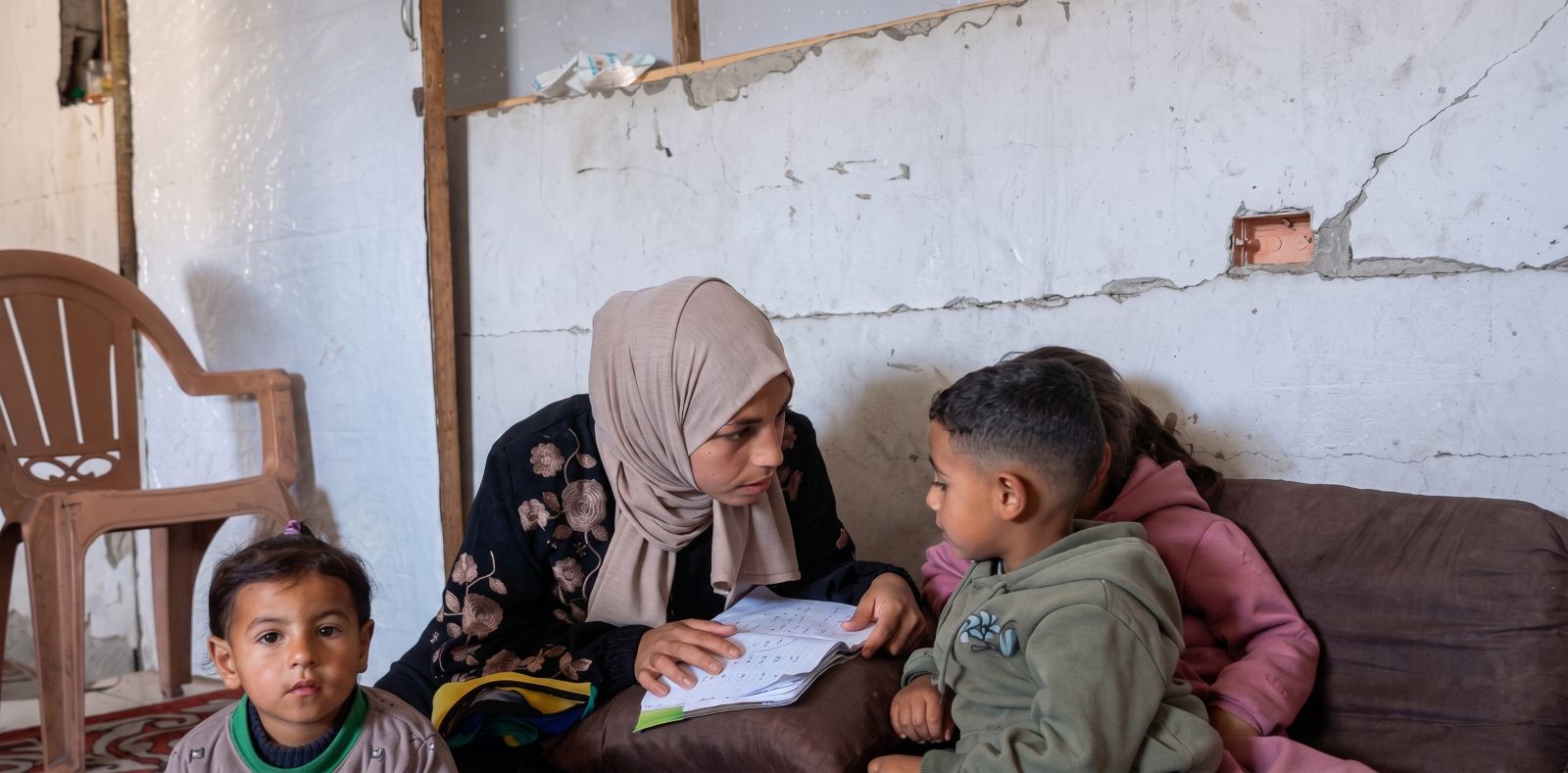
The Japanese Quarter, Khan Younis
In her late thirties, Hana was not only responsible for a newborn, but also for an entire household and a family that depended on her almost entirely. Her husband, who had a mental disability, was unable to manage the family's daily needs, leaving Hana as the sole caregiver for her home and four children, while pregnant with her fifth.
Before the war, Hana's house wasn't large or luxurious, but it was sufficient for her family: two living rooms, the kitchen and bathroom upstairs, and a corrugated iron roof that protected them from the rain and sun. A simple house, but it was their shelter.
Then came the bombing. The destruction left Hana and her family with almost nothing. The house lost its roof entirely, the kitchen and bathroom were destroyed, and the home that had sheltered her family for years became an open space exposed to the elements, without protection from the cold, rain, or heat. There was no longer a place fit to live, not even a safe place to sit.
The family was forced to flee to tents, and it was there that Hana spent the entire period of war and displacement. Those months were not fleeting; they extended to almost her entire pregnancy—nine months of anxiety, battling the cold and heat, the lack of privacy, and the responsibility of caring for four children and their father in a space no larger than a few meters of fabric. All this while her body carried a new life, and while she knew that the day of delivery, wherever it occurred, would not be easy.
But hope was beginning to emerge. With the launch of the Emergency Shelter Rehabilitation and Winterization Project in Gaza, implemented by the Gaza Agriculture and Environment Association (SAFE) in partnership with the United Nations Development Programme (UNDP), between October 2025 and March 2026, Hana's dwelling was among the 232 units included in the project. The renovation was no simple process; it was almost a complete reconstruction: a new roof replaced the open space exposed to the sky, a kitchen and bathroom were rebuilt from scratch, and water and sanitation networks were reconnected after a long period of disconnection.
Shortly before Hanaa gave birth to her fifth child, the renovations were completed, and the family returned home. For the first time in many months, Hanaa found herself within real walls and under a secure roof, not under the flimsy canvas of a tent that fluttered with every gust of wind. There, in that house that had been brought back to life, she gave birth to her child in a safe and warm place.
Hanaa sums up her experience in a simple sentence, but one that carries the weight of months of suffering:
"I was able to give birth in a safer and warmer place."
Behind these few words lies the story of a woman who single-handedly bore the burden of an entire family—a husband who needed care instead of providing it, four children, and a fifth pregnancy that unfolded under the harshest conditions imaginable for a mother. Yet, thanks to the timely renovations, this fifth child was not destined to begin life amidst dust and insecurity, but rather in a home that had been rebuilt specifically to welcome him.
Hanaa’s story is not just about walls that were rebuilt or a roof that was reinstalled, but about a woman who endured more than she could bear, and about a newborn who was given the chance to start his life in a place he deserves — a safe, warm home, ready to embrace a family that was given a helping hand in time.